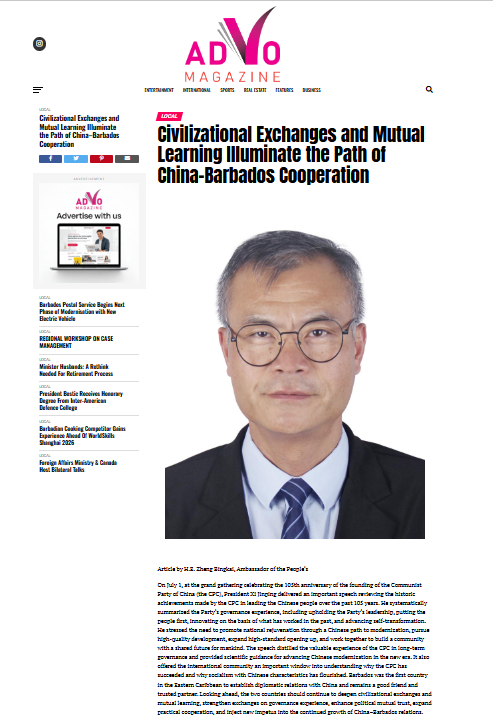
On 2 July, Ambassador Zheng Bingkai published a signed article entitled "Civilizational Exchanges and Mutual Learning Illuminate the Path of China–Barbados Cooperation" in two mainstream medias of Barbados, the Barbados Today and the Advo Magazine. Following is the full text of the article:
On July 1, at the grand gathering celebrating the 105th anniversary of the founding of the Communist Party of China (the CPC), President Xi Jinping delivered an important speech reviewing the historic achievements made by the CPC in leading the Chinese people over the past 105 years. He systematically summarized the Party's governance experience, including upholding the Party's leadership, putting the people first, innovating on the basis of what has worked in the past, and advancing self-transformation. He stressed the need to promote national rejuvenation through a Chinese path to modernization, pursue high-quality development, expand high-standard opening up, and work together to build a community with a shared future for mankind. The speech distilled the valuable experience of the CPC in long-term governance and provided scientific guidance for advancing Chinese modernization in the new era. It also offered the international community an important window into understanding why the CPC has succeeded and why socialism with Chinese characteristics has flourished. Barbados was the first country in the Eastern Caribbean to establish diplomatic relations with China and remains a good friend and trusted partner. Looking ahead, the two countries should continue to deepen civilizational exchanges and mutual learning, strengthen exchanges on governance experience, enhance political mutual trust, expand practical cooperation, and inject new impetus into the continued growth of China–Barbados relations.
Xi Jinping Thought on Party Building: A Scientific Guide for Party Governance and National Rejuvenation
Over the past century, the Communist Party of China has led the Chinese people in opening up a great path, achieving remarkable accomplishments, and developing innovative theories by grasping the laws and trends of historical development. Drawing insights from history, the tides of the times, and changes in the international landscape, the CPC Central Committee with Comrade Xi Jinping at its core has systematically summarized and elevated the practical experience of Party building in the new era, creating Xi Jinping Thought on Party Building.
The essence of this important thought ranges from upholding and strengthening the Party’s overall leadership, to advancing social transformation through the Party’s self-reform; from adhering to the principle that “The country is the people, the people are the country,” to taking simultaneous, coordinated, and comprehensive steps to ensure that officials do not have the audacity, opportunity, or desire to become corrupt. It profoundly reveals the laws governing the CPC’s long-term governance and self-development, providing a powerful ideological guide for China’s development and modernization. It is precisely under the scientific guidance of Xi Jinping Thought on Party Building that the CPC has maintained strategic resolve amid a complex and changing international environment and led the Chinese nation forward with confidence and determination.
Chinese Modernization: A New Model of Independent Development and Shared Prosperity
Under the strong leadership of the CPC, Chinese modernization has achieved remarkable successes and offered developing countries a new option for achieving modernization independently.
China met the poverty-reduction target of the United Nations 2030 Agenda for Sustainable Development ahead of schedule, lifting nearly 100 million rural residents out of poverty. It has established the world’s largest education system, social security system, and healthcare system, enabling more than 1.4 billion people to advance toward modernization. At the same time, a vast market exceeding the combined size of existing developed economies is taking shape.
Chinese modernization has never been a modernization pursued in isolation. China has consistently shared development opportunities with the world through high-level opening-up. During the 14th Five-Year Plan period (2021–2025), China contributed around 30 percent of annual global economic growth, remaining a major engine of the world economy. Through the Belt and Road Initiative, China has helped reduce global trade costs significantly and has provided development assistance to more than 160 countries.
As China enters the 15th Five-Year Plan period, it will continue to expand voluntary opening-up, creating broader market opportunities, growth opportunities, and cooperation opportunities for countries around the world, including Barbados.
Building a Community with a Shared Future for Mankind: China’s Contribution to Global Governance Reform
Guided by internationalism, the CPC has always linked the destiny of the Chinese people with that of people around the world, aligning the Chinese Dream of national rejuvenation with the vision of building a community with a shared future for mankind.
Today, the world is undergoing profound changes unseen in a century. Regional conflicts continue to emerge, while global challenges grow increasingly complex. President Xi Jinping has proposed the vision of building a community with a shared future for mankind, together with the Global Development Initiative, Global Security Initiative, Global Civilization Initiative, and Global Governance Initiative, contributing Chinese wisdom and solutions to common challenges facing humanity.
These initiatives have evolved from concepts into concrete actions. China is the second-largest contributor to United Nations peacekeeping operations and the largest troop contributor among the permanent members of the UN Security Council. Under the framework of the Global Development Initiative, China has launched more than 1,800 cooperation projects, organized training programs for over 80,000 participants, and implemented zero-tariff treatment for all products from African countries and least-developed countries that maintain diplomatic relations with China.
China actively promotes solidarity and self-strengthening among Global South countries, advances high-quality Greater BRICS cooperation, and implements eight major measures supporting Global South cooperation. It is also building new platforms for global governance, including the International Organization for Mediation and the World Data Organization, while accelerating preparations for a World Artificial Intelligence Cooperation Organization. This autumn, China will host the inaugural Xiong’an Global Governance Forum.
China remains committed to being a builder of world peace, a contributor to global development, and a defender of the international order. It stands ready to work with all countries to promote a more just and equitable international order.
Civilizational Exchanges and Mutual Learning: Injecting New Momentum into China–Barbados Mutual Political Trust
As President Xi Jinping noted during his meeting with Prime Minister Mia Amor Mottley, though separated by vast oceans, China and Barbados share similar goals and have move forward hand in hand, with bilateral relations constantly deepening and growing.
The exchange of governance experience is an important foundation for deepening relations between countries. China is willing to enhance dialogue among civilizations with all countries and respects every country’s right to choose its own development path independently.
As an important country in the Caribbean, Barbados possesses unique political institutions and valuable governance experience. As fellow developing countries, China and Barbados share many common interests in development and enjoy broad prospects for cooperation. Strengthening exchanges and mutual learning between the two civilizations will enrich bilateral relations with deeper contemporary significance.
China stands ready to further enhance exchanges at all levels with Barbados, including between political parties, and to deepen cooperation in areas such as poverty reduction, climate change, and governance capacity building. China is also willing to share the CPC’s experience in self-reform and its practical explorations in the process of modernization.
Through mutual learning and shared development experience, China and Barbados can jointly improve governance capacity and public administration, inject new momentum into political mutual trust, and contribute to building an even closer China–Barbados community with a shared future.